Chapter 01
Older than most of Earth's crust
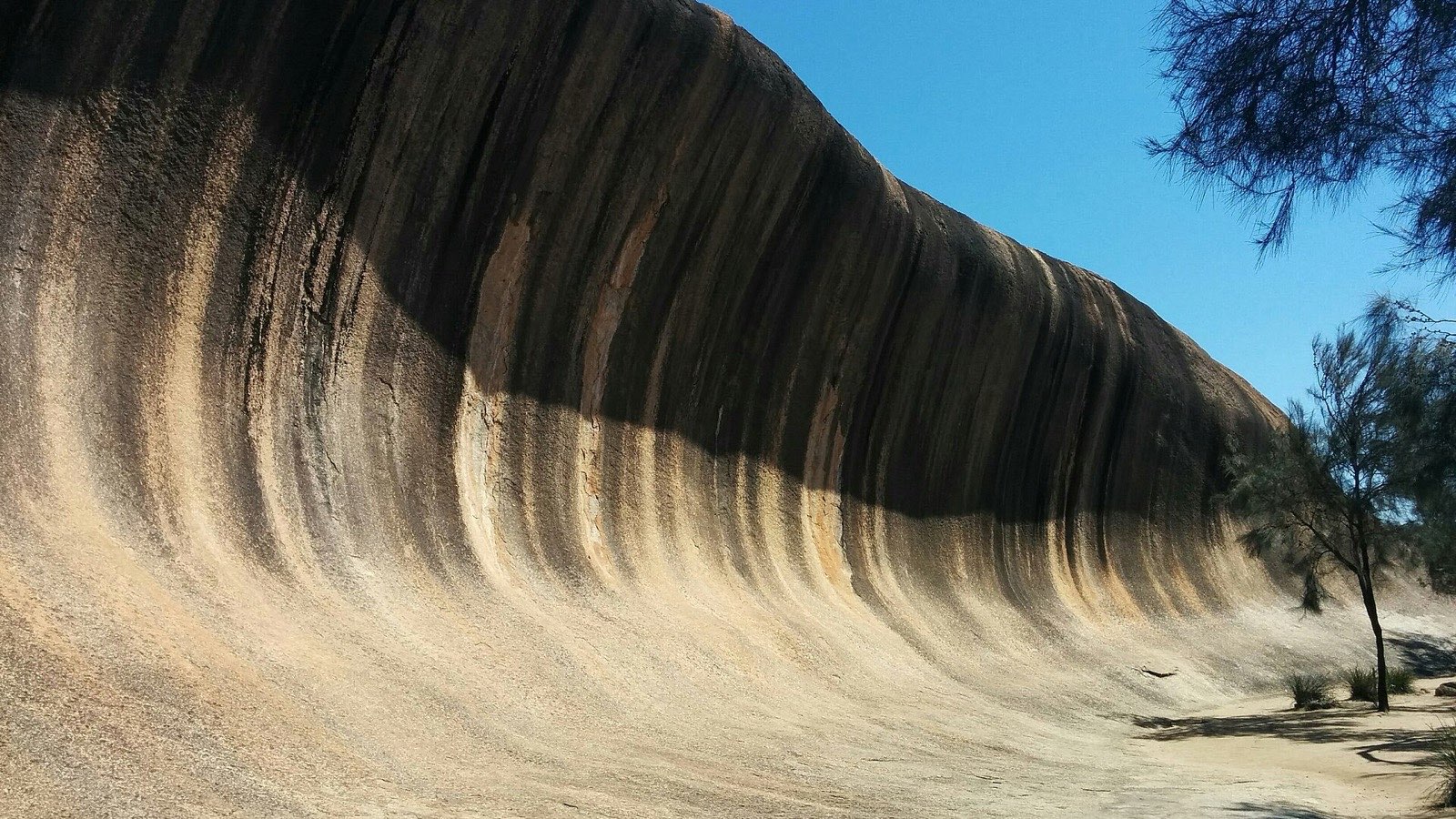
Hyden Rock is 2.63-billion-year-old biotite K-feldspar porphyritic monzogranite, part of the Yilgarn Craton. It stands as an inselberg 296 km east-south-east of Perth.
Location
Hyden, Western Australia
Rock
Porphyritic monzogranite
Age
Archaean · 2.63 Ga
Process
Flared slope (subsurface weathering)
Status
Open · Hyden Rock reserve
Overview
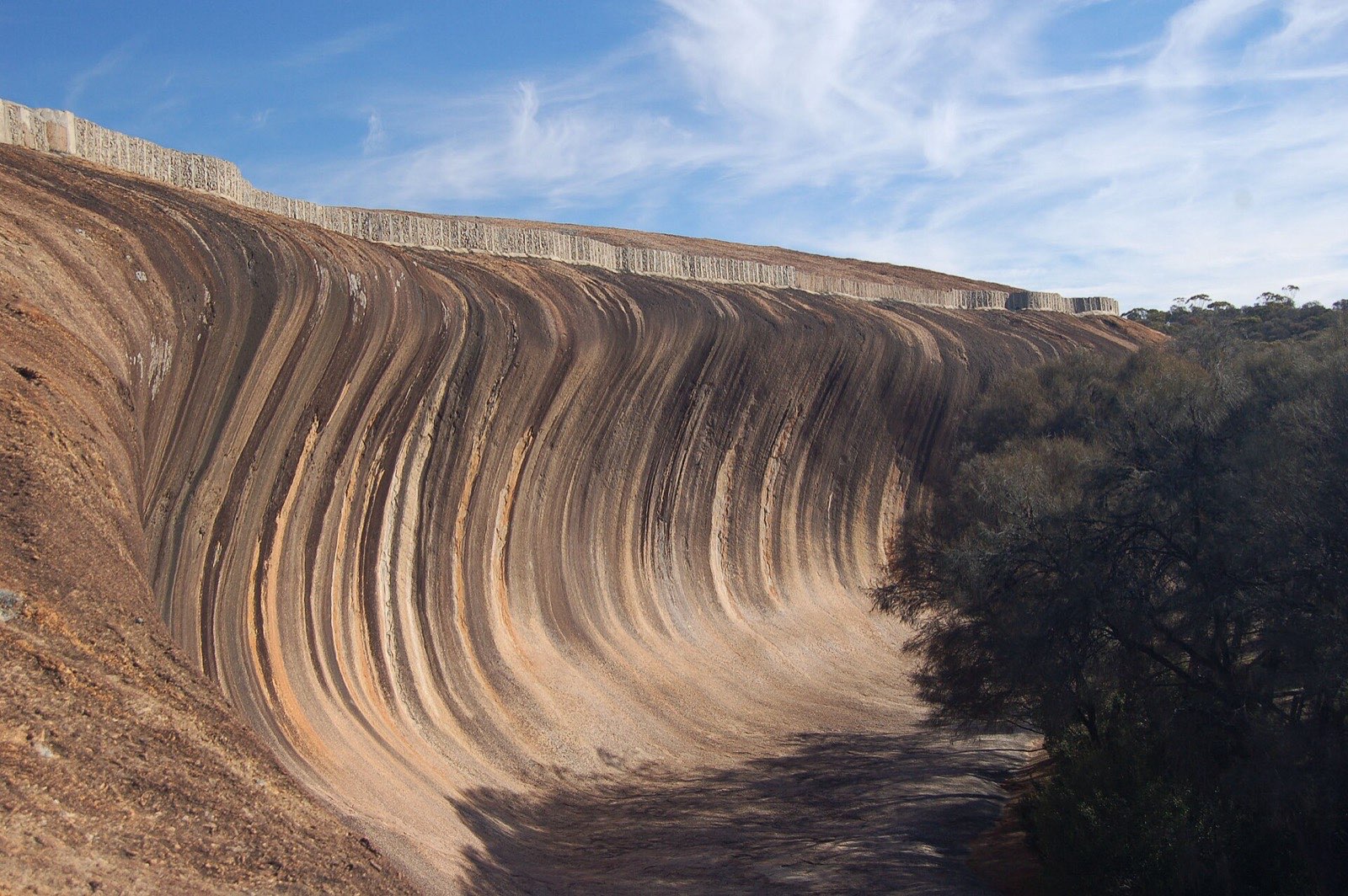
On the northern side of Hyden Rock, a wall of granite curves overhead like a breaking wave. It was shaped underground, long before anyone could see it.
2.63Ga
Age of the Hyden Rock granite
15m
Height of the wave
110m
Length of the wave
Chapter 01
Hyden Rock is 2.63-billion-year-old biotite K-feldspar porphyritic monzogranite, part of the Yilgarn Craton. It stands as an inselberg 296 km east-south-east of Perth.
Chapter 02
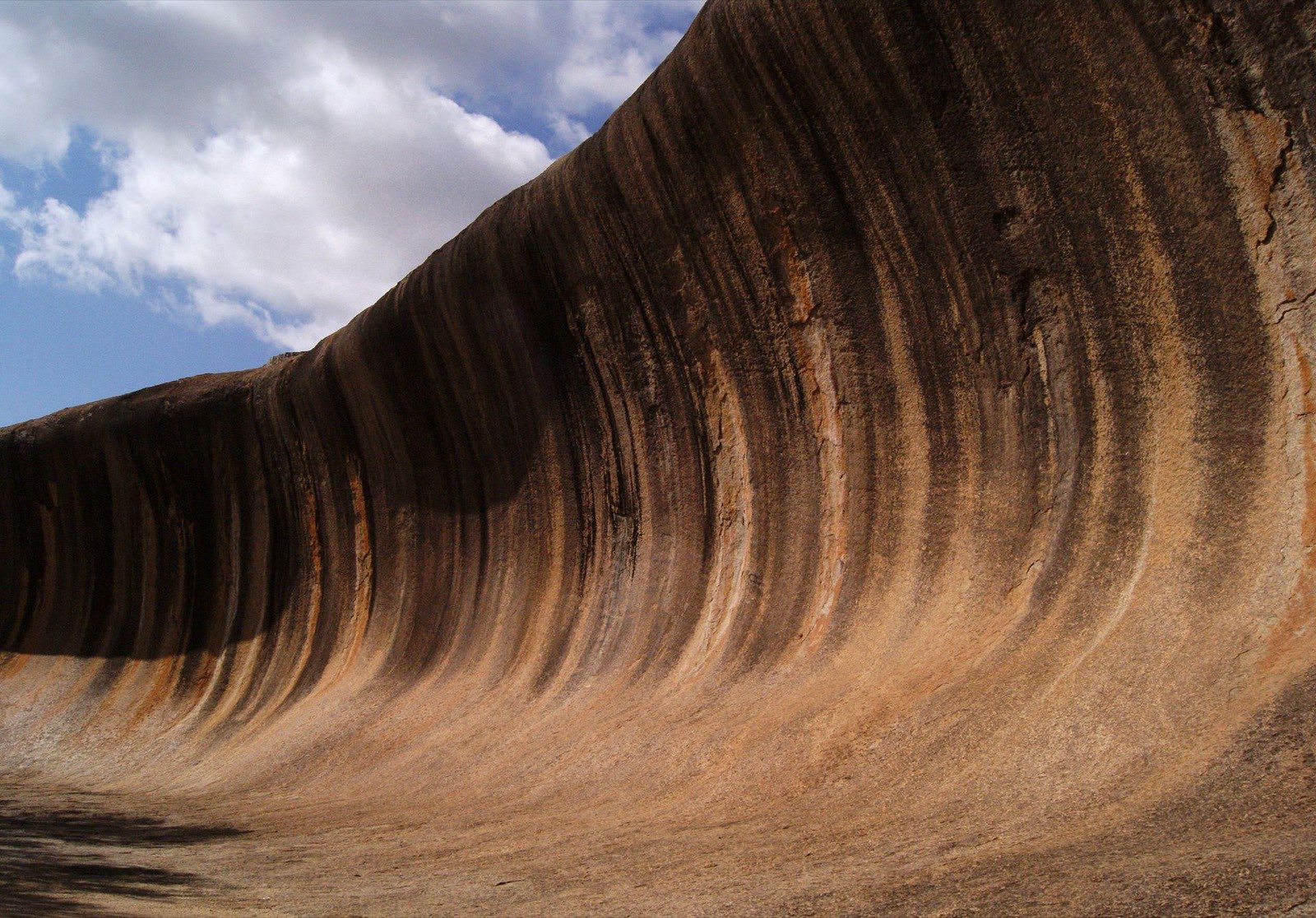
Geologists classify the wave as a flared slope. Groundwater held against the base of the granite slowly weathered it chemically below the old soil surface, cutting a concave notch while the rock above stayed dry.
Chapter 03
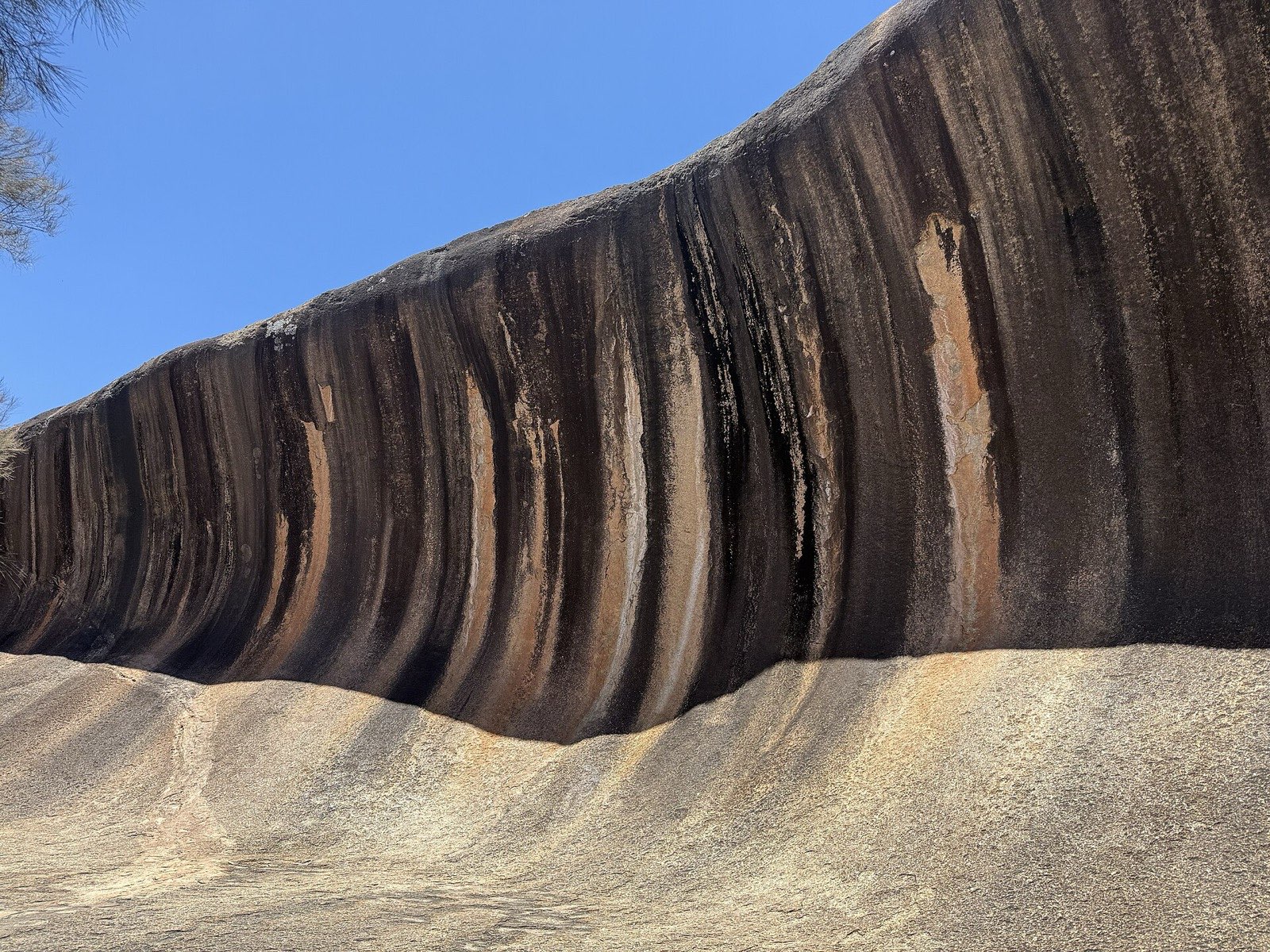
As the surrounding land was lowered by erosion, the notch was exposed as a smooth overhang. Rain running off the dome now paints it with vertical streaks of carbonates and iron hydroxides.
Chapter 04
The vertical bands of grey, ochre and cream are not in the granite itself. They are stains left by rainwater running off the top of the rock, carrying carbonates and iron down the curve.
Chapter 05
Flared slopes are common around the granite hills of the Yilgarn. Wave Rock is simply the most dramatic example; nearby Hippo's Yawn is another hollow carved the same way.
How it forms
Hyden Rock sits beneath a thick soil cover. Groundwater collects against the granite at the soil line.
Moisture chemically rots the granite at and just below the soil surface, cutting a concave notch.
Over long periods the surrounding land is lowered and the loose, weathered debris is washed away.
The notch is left standing as a smooth, overhanging curve, then streaked by rain running off the dome.
A wave that was carved in the dark, under the soil, and only later brought into the light.
The question
Weathering was strongest exactly where the rock met the damp soil and faded upward and downward from there. Remove the soil, and that band of maximum rotting becomes a concave curl.
Flared slope (subsurface weathering)
Deep time
2.63 Ga
Granite
Magma crystallises into the monzogranite of the Yilgarn Craton.
Deep time
Under the soil
Moisture at the old soil line slowly weathers a notch into the buried granite.
Later
Exhumation
The plains are lowered and the flare is exposed as a free-standing wave.
Today
15 × 110 m
The wave stands about 15 m high and 110 m long on Hyden Rock's north face.
Field record
Field data
IGMA simulation · move to heat
Rock Lab
Turn a 3D model of Wave Rock with hand gestures, heat its surface with your fingertip and weather it through 250,000 years.
Enter the Rock LabReferences
Photography
Next case · 04
A forest of limestone, dated