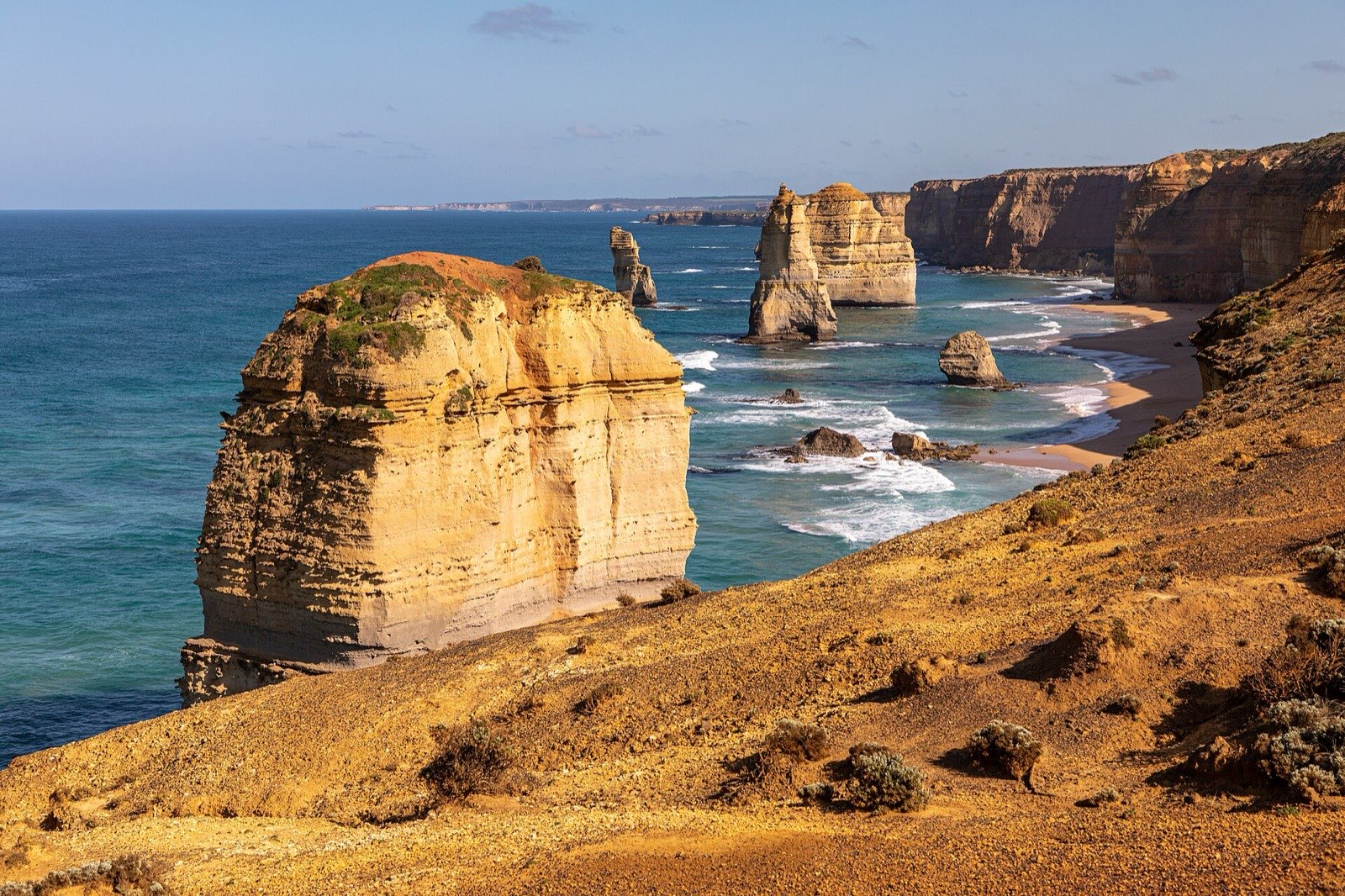
Chapter 01
A seabed, lifted
Port Campbell Limestone was laid down on a shallow sea floor between about 15 and 5 million years ago, built from the shells and skeletons of marine life, then lifted to form the cliffs.
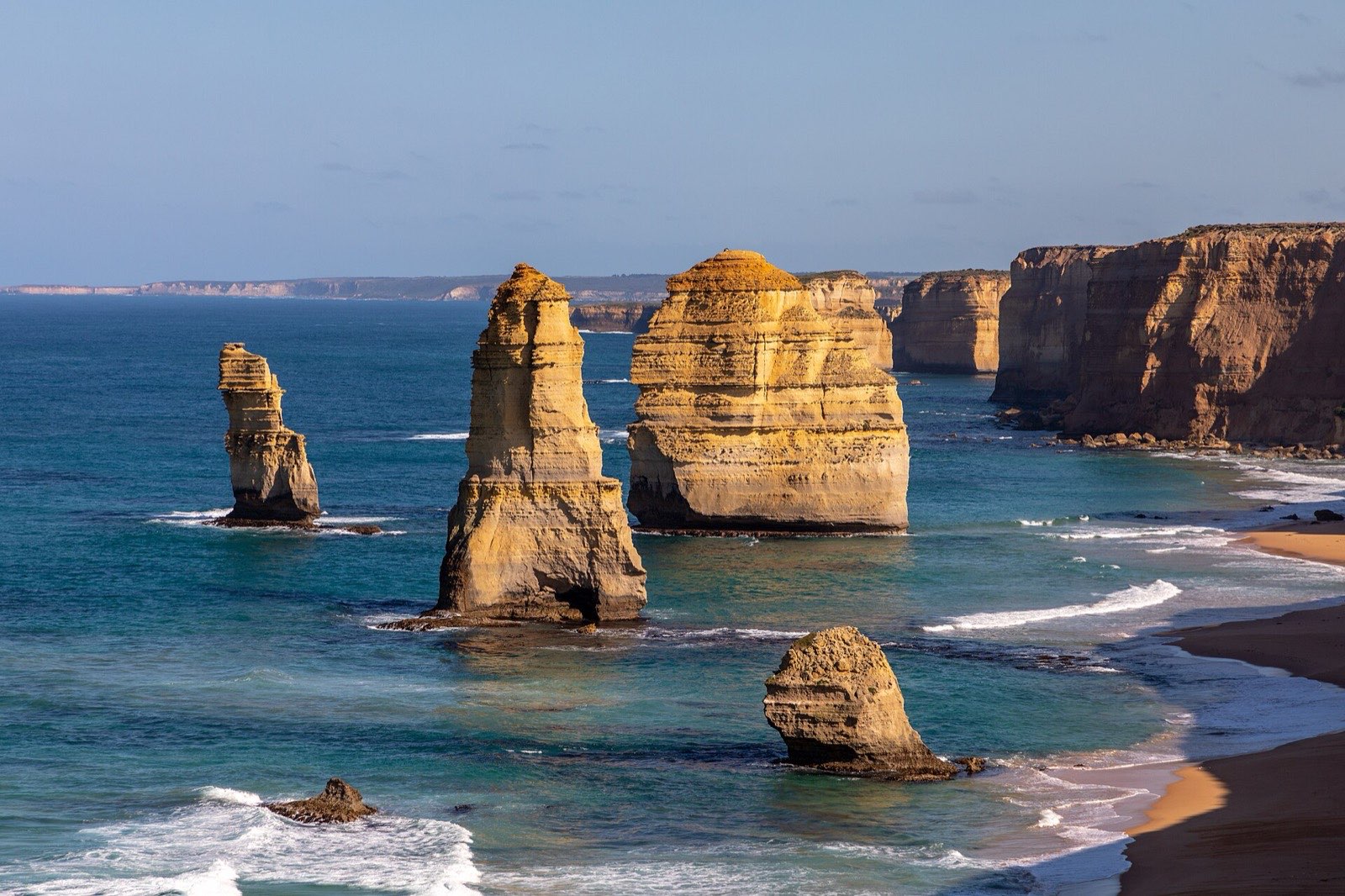
Location
Port Campbell National Park, VIC
Rock
Port Campbell Limestone
Age
Mid–Late Miocene · ~15–5 Ma
Process
Coastal erosion (cave → arch → stack)
Status
Seven of nine stacks standing
Overview
Off the Great Ocean Road, limestone pillars up to 50 metres tall stand in the Southern Ocean. They were once part of the mainland cliff, and the same waves that freed them are now taking them down.
50m
Height of the tallest stacks
7of 9
Stacks still standing
2005
Year a 50 m stack collapsed
Chapter 01
Port Campbell Limestone was laid down on a shallow sea floor between about 15 and 5 million years ago, built from the shells and skeletons of marine life, then lifted to form the cliffs.
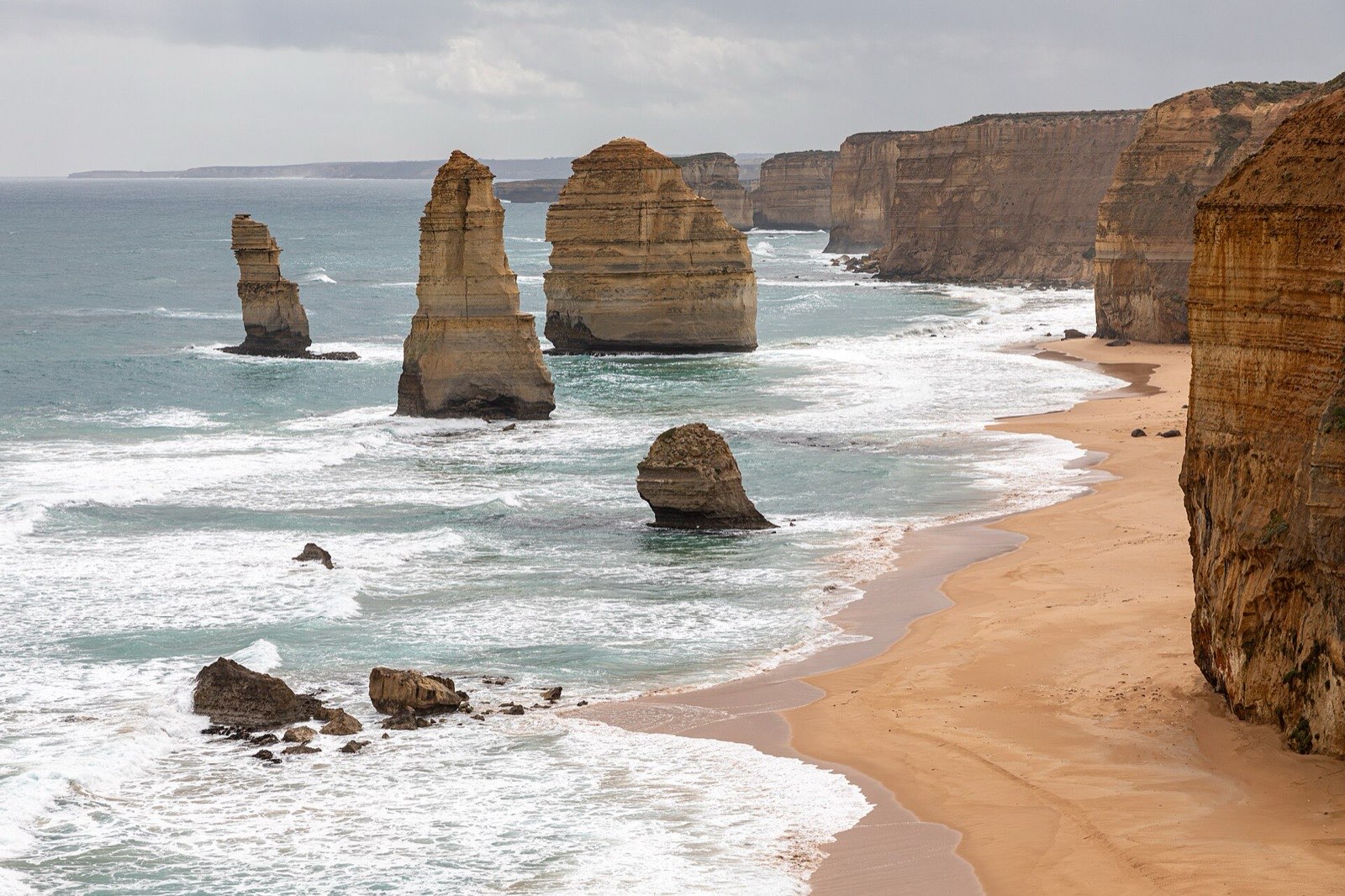
Chapter 02
Southern Ocean swells work into weaknesses in the cliff, hollowing caves. Caves on either side of a headland meet as an arch; when the arch roof falls, a free-standing stack remains.
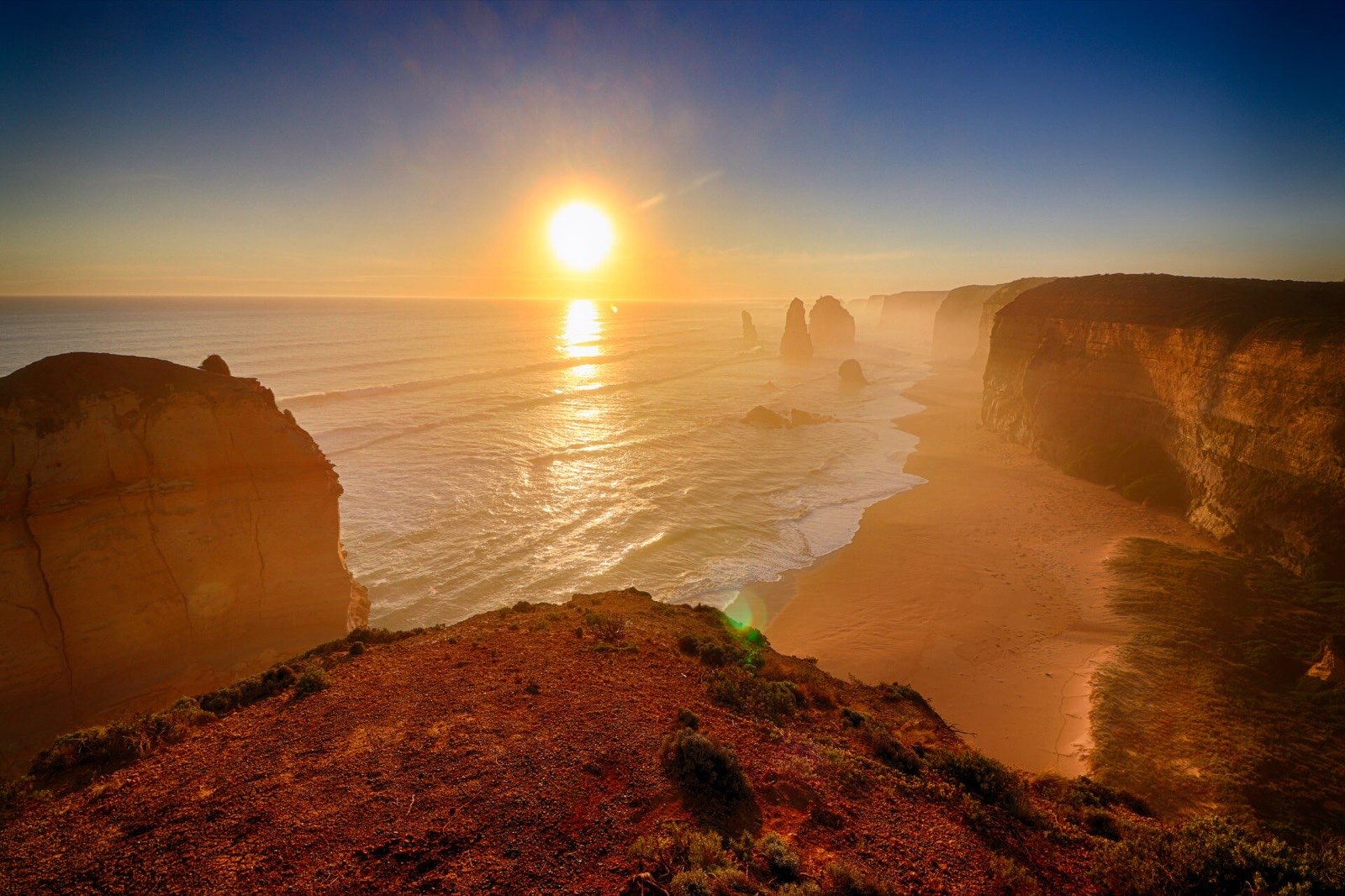
Chapter 03
Known first as the Sow and Piglets, the stacks were renamed the Twelve Apostles to draw visitors, though there were only ever nine. In July 2005 a 50-metre stack collapsed; another fell in 2009.
Chapter 04
Waves do most of their work in a narrow band at sea level. Stacks are notched at their base while their tops stay intact, until the notch is deep enough that the pillar falls.
Chapter 05
The same process that removes old stacks is carving new ones from the cliffs behind. The formation is not disappearing so much as moving slowly inland.
How it forms
A continuous limestone cliff meets the Southern Ocean. Waves attack its joints and weaker beds.
Pounding swells hollow sea caves into both sides of a narrow headland.
The caves meet through the headland and open into an arch.
The arch roof collapses, leaving a free-standing stack that the waves keep undercutting.
The coast doesn't lose these pillars. It makes them, and then it takes them back.
The question
Because the cliff is not uniform. Waves find joints and softer layers first, carving caves and arches there, and leave stronger blocks standing alone offshore.
Coastal erosion (cave → arch → stack)
Deep time
~15–5 Ma
Sea floor
Shells and skeletons settle on a shallow Miocene sea floor, building the Port Campbell Limestone.
Later
Cliffs
The limestone is lifted and the Southern Ocean begins cutting a cliffed coast.
July 2005
Collapse
A 50-metre stack falls into the sea, leaving eight.
2009
Seven left
Another stack collapses; seven of the original nine remain.
Field record
Field data
IGMA simulation · move to heat
Rock Lab
Turn a 3D model of Twelve Apostles with hand gestures, heat its surface with your fingertip and weather it through 250,000 years.
Enter the Rock LabPhotography
Next case · 08
Beehive domes painted by bacteria