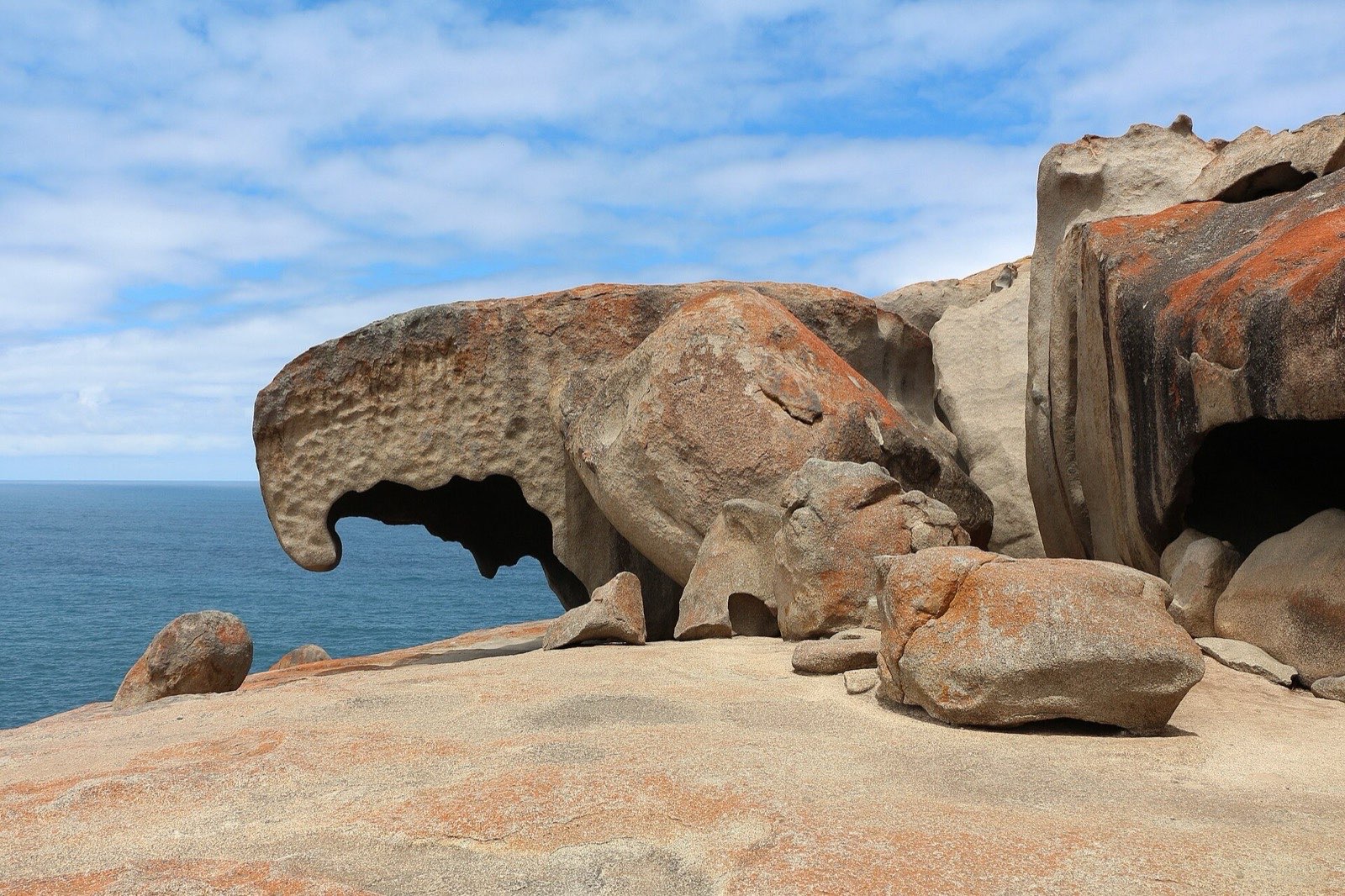
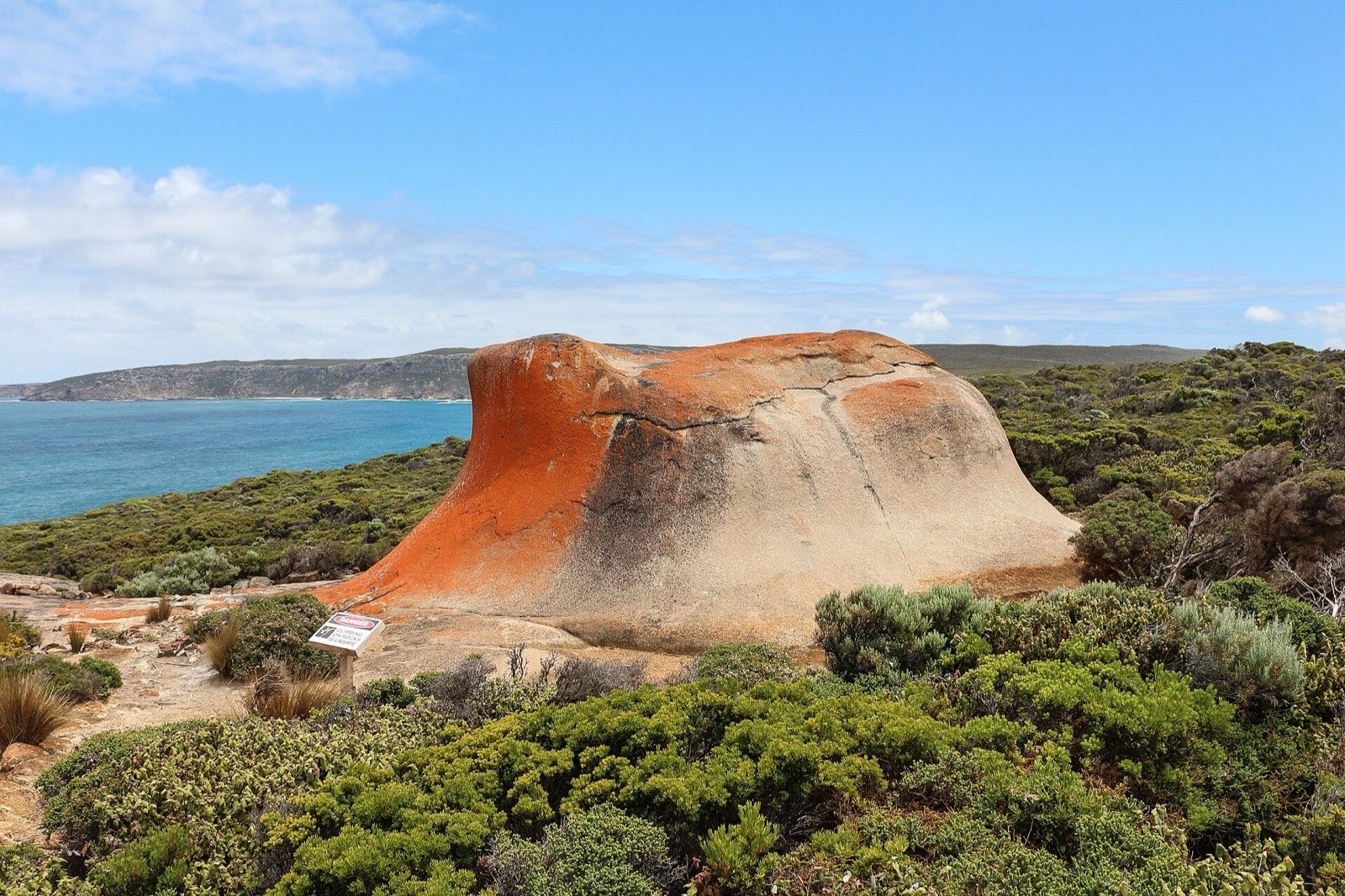
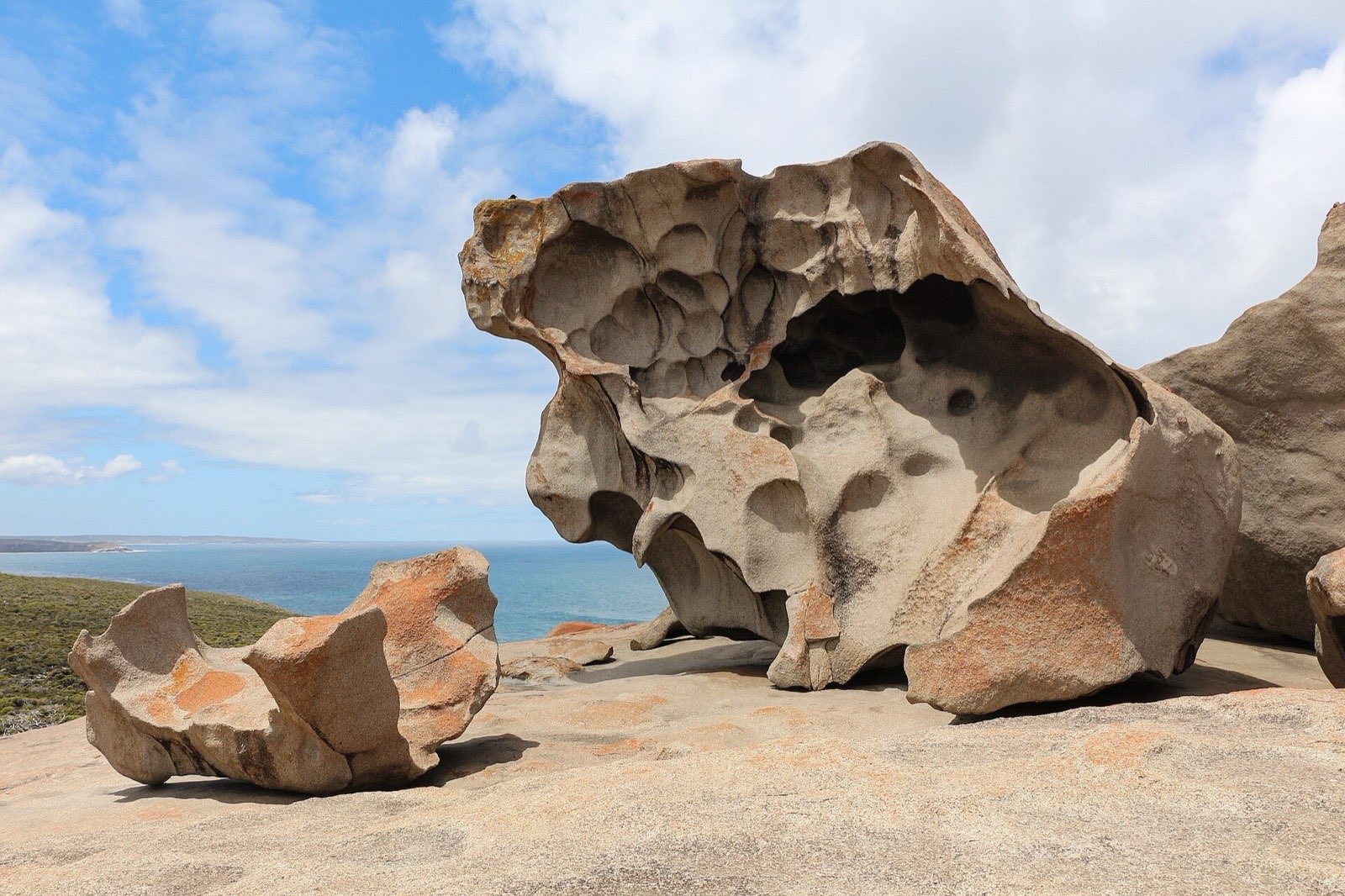
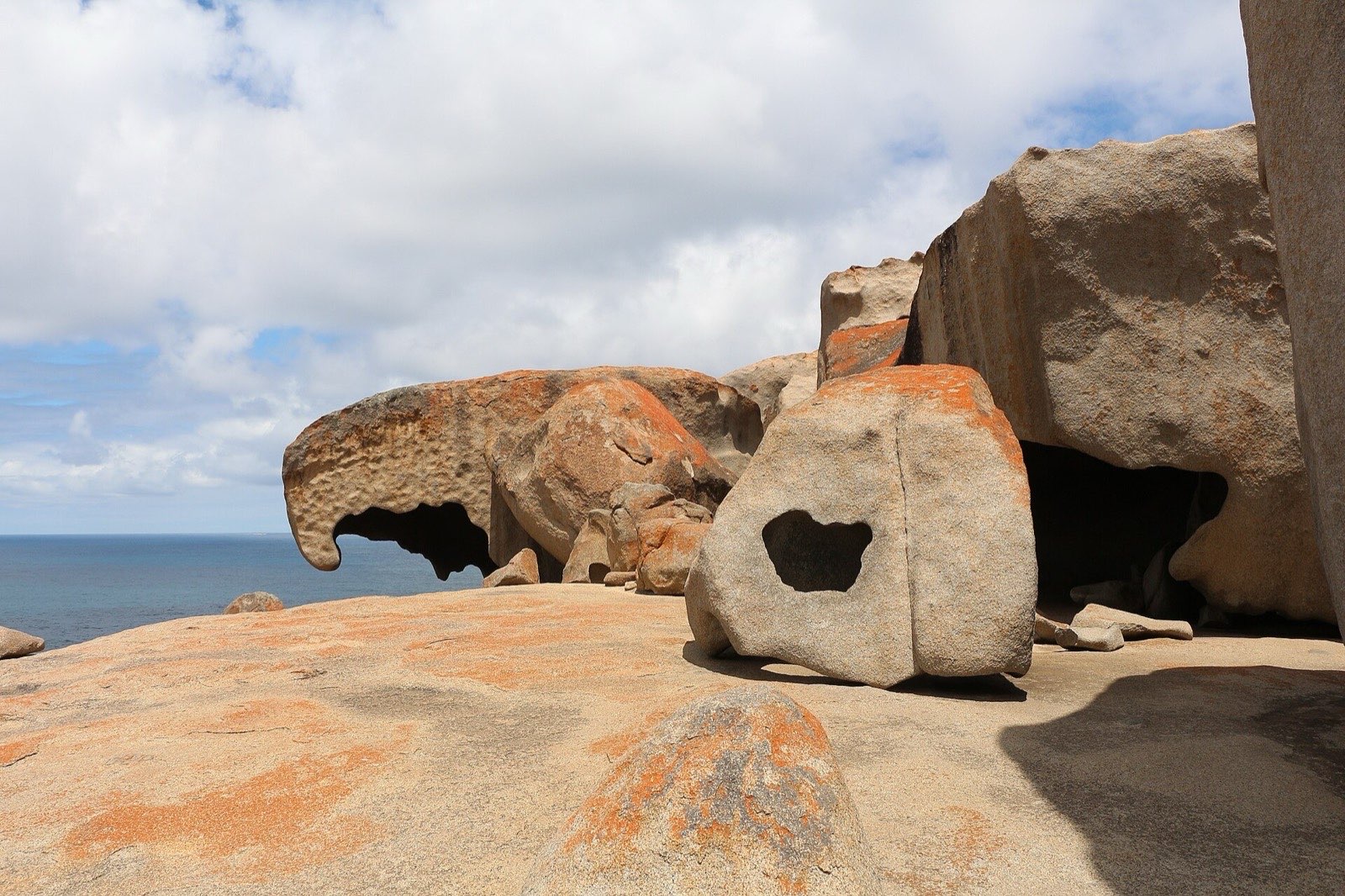
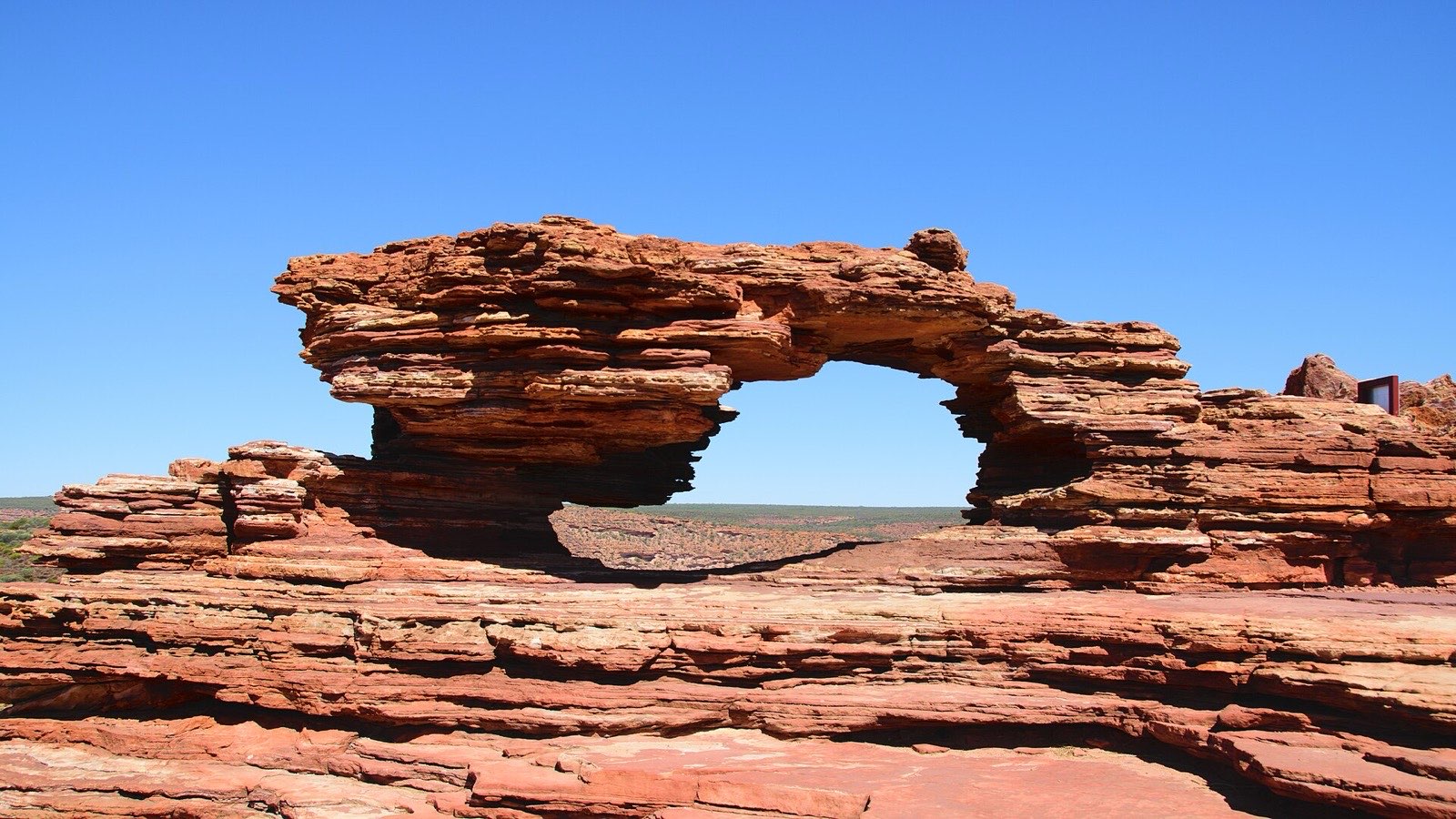
On a granite dome above the sea, huge boulders have been hollowed into shells, arches and beaks. Orange lichen coats their outer skins; inside, the hollows are clean and bright.
About 500 million years ago, when Kangaroo Island was part of Gondwana, magma cooled into the granite here: black mica, bluish quartz and pinkish feldspar. The boulders are corestones resting on a partly exposed granite dome.
Chapter 02
Cavities up to 20 m
Salt-laden spray, wind and strong swings in temperature and humidity have carved some of the most striking tafoni known, with granite cavities up to 20 metres across.
Chapter 03
Painted by lichen
The golden-orange crust on the rocks is an extremely slow-growing lichen; grey and green lichens take over in less exposed spots. The Geological Society of Australia lists both Remarkable Rocks and nearby Cape du Couedic as geological monuments.
Chapter 04
Shells and beaks
Some boulders are now more air than stone. Where two hollows meet, or a hollow breaks through to the outside, the granite is left as a curved shell only centimetres thick, like a cracked egg.
Chapter 05
After the fire
The 2019–20 bushfires burned through Flinders Chase National Park. The granite endured; the visitor boardwalk around the rocks was rebuilt after the fires.
Illustration · stage 1 / 4
How it forms
01
Magma
About 500 million years ago, molten rock cools slowly underground into granite.
02
Corestones
Weathering along joints rounds the granite into boulders that sit on a dome.
03
Hollowing
Salt spray and damp shade attack the undersides; cavities grow into the boulders.
04
Shells
Cavities break through, leaving thin shells, arches and beaks of granite.
The lichen is a map. Where the orange ends, the rock is still moving.
Undersides stay shaded and damp and collect salt, so they weather fastest. The sunlit tops dry quickly and are armoured by slow-growing lichen, so the boulders are eaten from underneath.
Tafoni on granite corestones
Deep time
How long it took
~500 Ma
Granite
Magma cools into granite while Kangaroo Island is part of Gondwana.
Deep time
Corestones
Weathering separates the granite into rounded boulders on a dome.
Coastal era
Salt and wind
Southern Ocean spray hollows the boulders into tafoni.
2019–20
Fire
Bushfires sweep Flinders Chase; the site is later reopened.