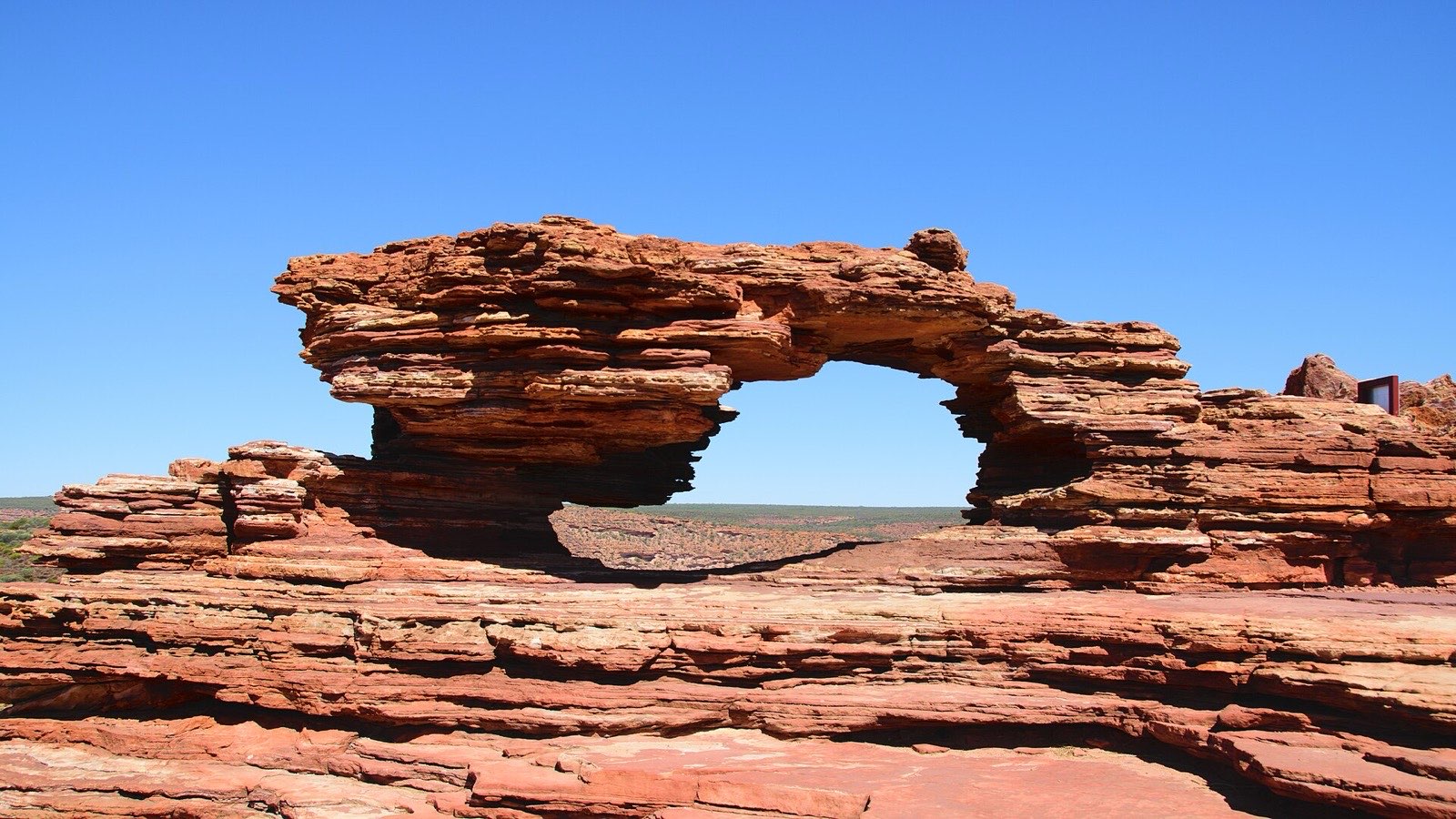
Nature's Window, Kalbarri National Park.
Case 06 / 09Where animals first walked on land-27.8570° S, 114.4540° E

Nature's Window

Nature's Window, Kalbarri National Park.

Location

Kalbarri National Park, WA

Rock

Tumblagooda Sandstone

Age

Silurian? · ~400–430 Ma

Process

Joint-guided erosion

Status

Open · The Loop trail

Overview

High above the Murchison River, a band of red-and-white sandstone has been worn through into an arch. The rock around it preserves some of the earliest footprints of animals on land.

400–430Ma

Approximate age of the Tumblagooda Sandstone

1fossil

Body fossil found: Kalbarria

11leg pairs

On Kalbarria, a euthycarcinoid

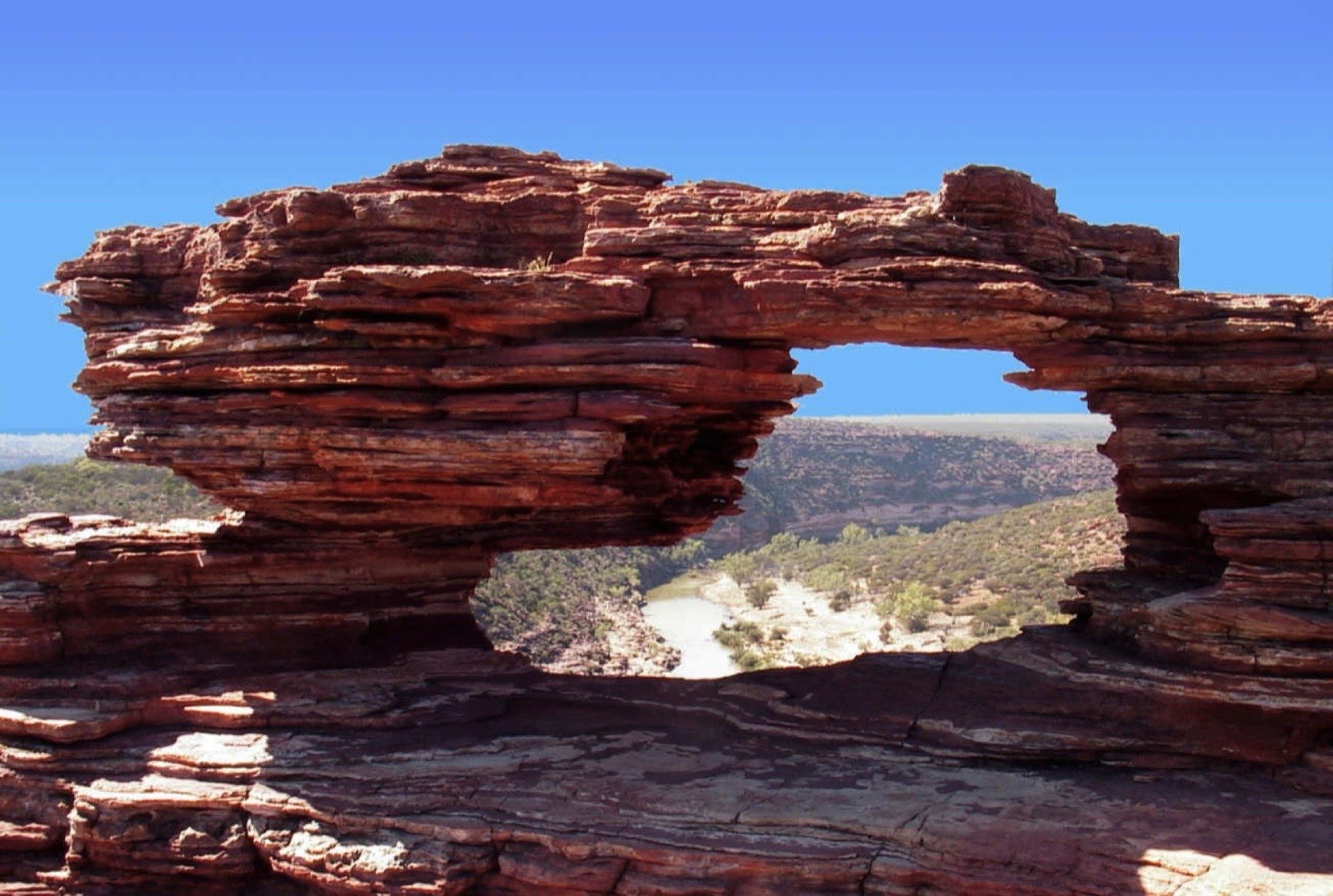
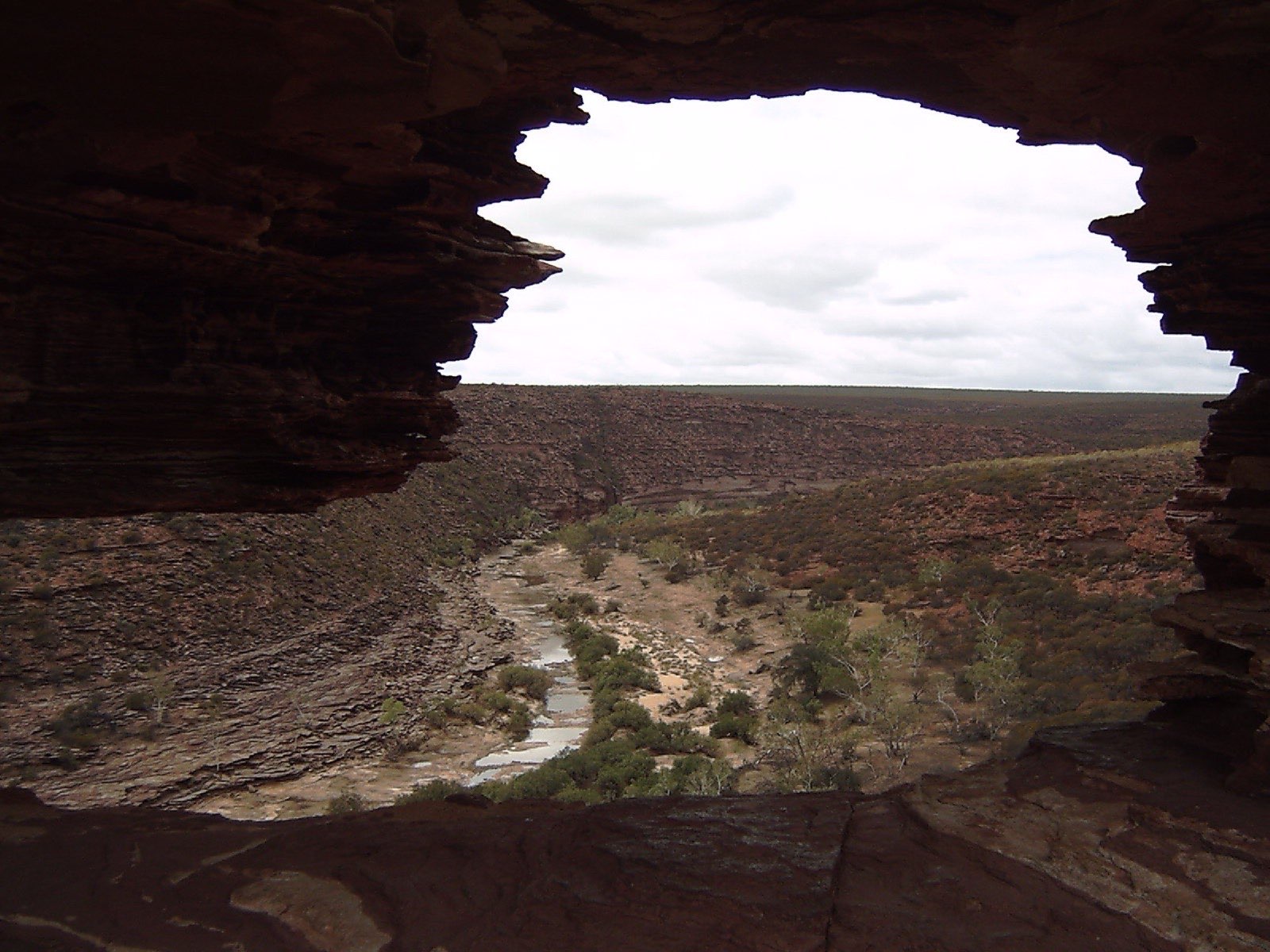
The arch framing the Murchison River gorge.

Chapter 01

Sand from an ancient coast

The Tumblagooda Sandstone is a banded red and white sedimentary rock laid down by rivers and tidal flats. Its age is still poorly constrained, but Ordovician to Silurian, roughly 400–430 million years, is currently most likely.
Banded red and white Tumblagooda Sandstone.

Chapter 02

Tracks of the first walkers

The rock is crowded with trackways left by myriapods, eurypterids, euthycarcinoids, xiphosurids and scorpion-like animals. Only one body fossil has been found: Kalbarria, a euthycarcinoid with 11 pairs of legs.

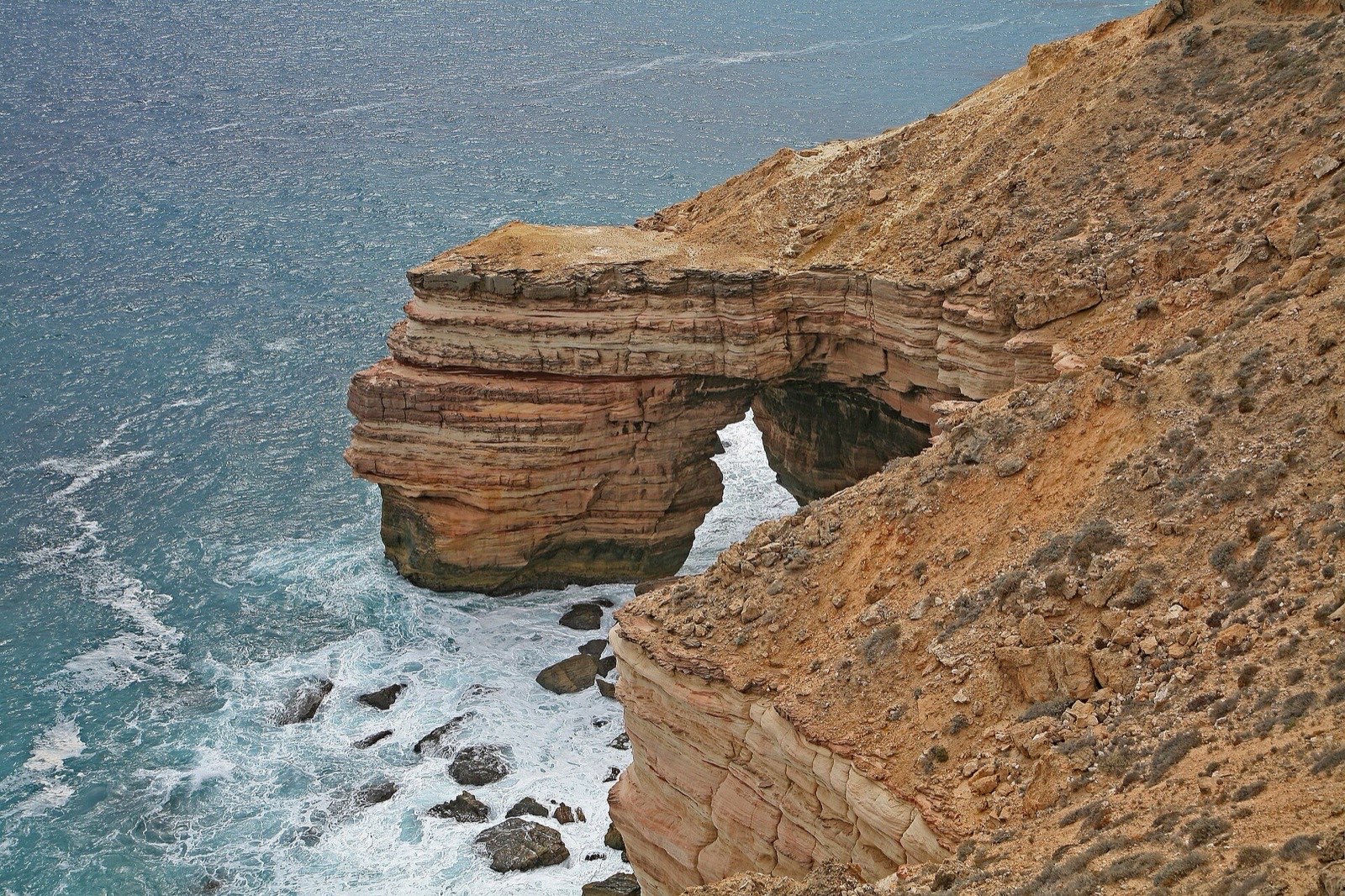
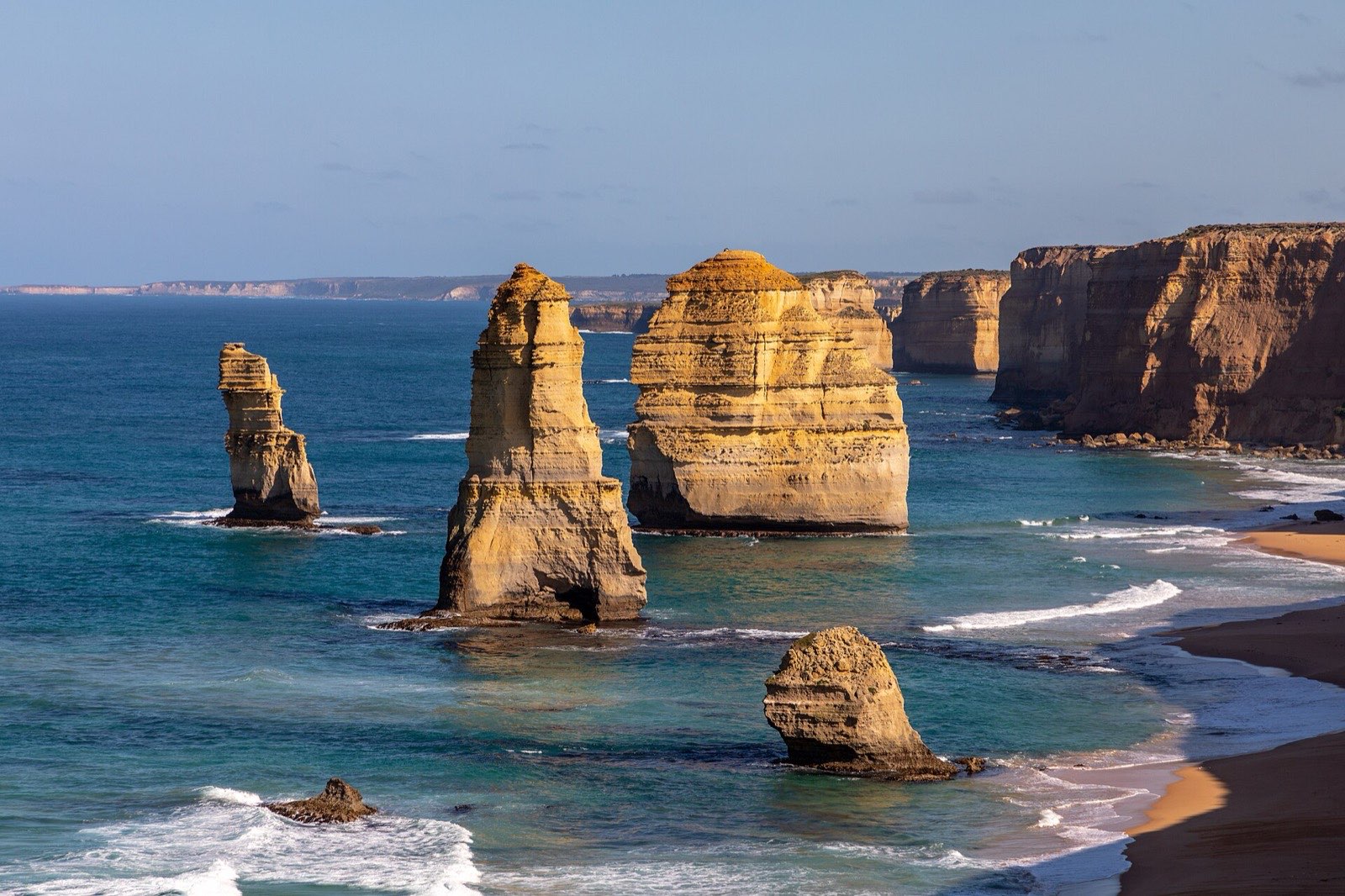
Kalbarri coast, Tumblagooda cliffs.

Chapter 03

An arch along the joints

Erosion exploited joints and weaker bedding in the sandstone, undercutting a layer until a window opened through it. It now frames the gorge on the Loop trail.

Nature's Window, Kalbarri National Park.

Chapter 04

Written in ripples

The banded red and white layers still carry ripple marks from the currents that shaped them, and the surfaces around the gorge preserve the tracks of animals that walked on this shore.

The arch framing the Murchison River gorge.

Chapter 05

Floods cut the gorge

The Murchison River has cut down through the Tumblagooda Sandstone to form the gorge. Nature's Window sits high on the rim, framing the river's meander below.

Illustration · stage 1 / 4

How it forms

  1. 01

    Tidal flats

    Sand is laid down in layers on ancient river and tidal flats, rippled by currents.

  2. 02

    Rock and cracks

    Buried, the layers harden into sandstone and are broken by vertical joints.

  3. 03

    Undercut

    A weaker layer erodes faster beneath a harder band, guided by the joints.

  4. 04

    Window

    The hollow breaks through while the harder band above holds as a natural arch.

Banded red and white Tumblagooda Sandstone.

A window cut by time, beside the footprints of animals that first stepped out of the sea.

Banded red and white Tumblagooda Sandstone.Photo · ChatDaniels · CC BY-SA 3.0

The question

Why a window, not a collapse?

Because the layers are unequal. The weaker band below erodes into a hole, while the harder, well-cemented band above is strong enough to span the gap and hold as a bridge of rock.

Joint-guided erosion

Deep time

How long it took

  1. ~430–400 Ma

    Shoreline

    Sands and trackways are laid down on Silurian (or Ordovician) river and tidal flats.

  2. Deep time

    Stone

    The sands are buried and cemented into the Tumblagooda Sandstone.

  3. Later

    Gorge

    The Murchison River incises the sandstone, exposing its layers.

  4. Today

    Window

    A joint-guided hollow has broken through to frame the gorge.

Kalbarri coast, Tumblagooda cliffs.
Kalbarri coast, Tumblagooda cliffs.Photo · W. Bulach · CC BY-SA 4.0

Field data

Rock
Banded quartz sandstone
Age
Poorly constrained · likely Ordovician–Silurian
Trace makers
Myriapods, eurypterids, euthycarcinoids…
Body fossil
Kalbarria (euthycarcinoid)
Setting
Murchison River gorge

IGMA simulation · move to heat

Rock Lab

Hold Nature's Window in your hands

Turn a 3D model of Nature's Window with hand gestures, heat its surface with your fingertip and weather it through 250,000 years.

Enter the Rock Lab

Next case · 07

Limestone stacks in retreat

Twelve Apostles

Enter